

From Portrait Milano to the Mazzarò Sea Palace in Taormina, terraces, bars and restaurants are becoming places used by the local community too, contributing to hotel revenues
If you have never thought of having breakfast in a hotel even when you are not staying there, now may be the time to consider this new experience, which promises great rewards. For the palate, for the view and for the mood.
For some time now, hotel common spaces — such as terraces, bars and restaurants — have been opening up to the local community, and no longer only to in-house guests. The reasons are varied and, behind what might seem like a simple lifestyle trend, there is in fact a targeted reflection by hoteliers seeking to intercept new business opportunities.
For years, bars and restaurants inside hotels operated intermittently: the breakfast room, for instance, came to life only in the morning, before shutting down again until the following day, while the bar and restaurant were often underused because guests preferred to discover local venues. In the hotel’s economic balance, common spaces carried weight and were often loss-making. Hence the idea of opening them up to external guests, reorganising and refurbishing them, and hiring chefs — in some cases even Michelin-starred ones — to attract a new customer segment.
“Opening breakfast to external guests means transforming a service traditionally reserved for hotel clients into a new business opportunity.
It makes it possible to generate additional revenue, increase the visibility of the property and introduce the hotel experience to people who are not staying there,” explains Debora De Marco, Breakfast Experience Designer at Fas Italia. “For hotel chains and groups with several properties, breakfast also represents an important cross-selling opportunity: through loyalty programmes, dedicated offers, newsletter subscriptions and exclusive promotions, a simple breakfast customer can be turned into a regular guest.”
In Italy, the case that has set — and continues to set — the benchmark is Portrait Milano, created through the conversion into hotel use, designed by AMDL Circle, of a symbolic place in Milan’s sixteenth-century life, today at the heart of the Fashion District. Awarded “Best Breakfast in Italy” at the Best Luxury Hotel Awards 2024 and “Best Hotel Breakfast” at the Food & Wine Italia Awards 2025, the breakfast at Portrait Milano’s 10_11 Bar Giardino Ristorante is open both to hotel guests and to Milanese residents, travellers and visitors to the city. Set near the garden, the buffet celebrates the seasonality of raw ingredients through a pastry offer rooted in Italy’s gastronomic culture.
Among the desserts are torta paradiso, chocolate cake in caprese, anacaprese and tenerina versions, red fruit tart and pistachio frangipane cake with orange caramel and sour cherries. The selection changes daily according to the pastry chef’s inspiration. Depending on the season, guests may also find granita with brioche, pandoro and panettone, as well as the many desserts that tell the story of Italy through its annual celebrations and traditions.
For those seeking a natural burst of energy, the experience becomes interactive at the “juice corner”: guests choose their preferred seasonal fruit and vegetables, compose their own basket and hand it to the dining room staff, who prepare a personalised drink.
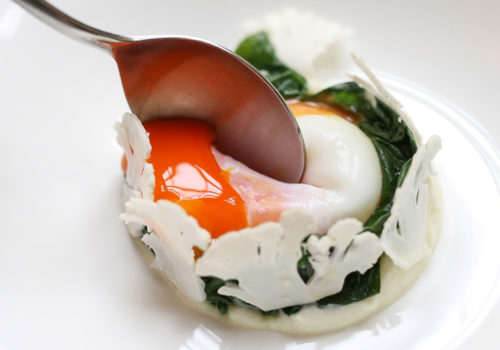
There is also a dedicated egg menu: not to be missed are the Milanese egg with taleggio foam and saffron sauce, and the Italian egg on tomato sauce with gratinated cheese.


Rituals are also proving popular, such as that of coffee. Every morning, the coffee trolley moves between the tables, carrying with it the unmistakable aroma of the moka pot. The coffee is prepared directly in the dining room using the “Pulcina” moka pot designed by architect Michele De Lucchi, who, together with his studio, also oversaw the restoration of the complex that houses Portrait Milano.
Increasingly often, hotel entrepreneurs are turning to architects and designers to make breakfast spaces — and the hotel as a whole — more attractive and capable of telling a story. These are significant investments, certainly, but they help reposition the hotel and reach a new clientele, one that is increasingly demanding and aware.
“The breakfast experience begins long before the first taste: it starts with the spaces. To win over this clientele, offering a good buffet is not enough: you need to create an experience that leaves a mark. That is why it is important to invest in the design of spaces and rely on professionals such as architects and designers, who can translate the hotel’s identity into a coherent and memorable environment,” comments Debora De Marco.
Historic and more prestigious hotels are also opening up to external guests, such as The Excelsior, a Luxury Collection Hotel, Florence, which has recently renewed its spaces, including the breakfast area, working with Moinard Bétaille as well as Martin Brudnizki. Remaining in Brunelleschi’s city, Hotel Calimala, whose restyling was entrusted to Alex Meitlis, offers breakfast on the terrace overlooking the rooftops of Florence.
“Every detail contributes to the perception of quality,” De Marco points out. “The layout of the room, natural light, acoustics, seating comfort, the arrangement of the buffet, the mise en place, materials, scents and even the presentation of the food. Today, design does not only have an aesthetic function: it guides guests’ movements, improves comfort, encourages conviviality and makes the experience more enjoyable and shareable on social media. In an increasingly competitive market, it is precisely the sum of these details that transforms a simple breakfast into a memory that encourages people to return and talk about it.”


And then we arrive in the south, specifically in Taormina, where VOIhotels, with its VRetreats brand, is also focusing on the restyling of its spaces as a driver for hotel repositioning. In this case, we are at the Mazzarò Sea Palace, located in the bay of the same name, where architecture studio De.Tales has conceived the interiors as echoes of the territory’s defining elements: the sea, the volcano, the cliffs overlooking the Ionian. Every corner and every detail evokes a Mediterranean atmosphere, from the rooms to the terraces, both private and public, all the way to the breakfast room opening onto the seafront terrace.
At the Mazzarò Sea Palace, breakfast is defined above all by its local character. The buffet and its various islands are a triumph of Sicilian identity: they include, among other things, cannoli, cassata, granita with brioche made sometimes with Maletto strawberries, recognised by the Slow Food Ark of Taste, sometimes with Interdonato lemon, a Slow Food Presidium, and sometimes with Avola almonds, part of the Noto almond group and therefore also a Slow Food Presidium. There are also small arancini and Catanese cartocciate, Sant’Angelo salami and Nebrodi salami.
Choosing local products means pursuing sustainability, supporting small local suppliers and producers and, consequently, promoting zero-kilometre sourcing. These are also themes that feed into the valuable tool of storytelling, through which guests can be fascinated and made more aware, because culture also passes through food and every bite tells, in this case, a story linked to Sicily and its people.


Cover image: The mise en place at 10_11 Bar Giardino Ristorante / Portrait Milano. Courtesy of Portrait Milano